Top Luxury Desert Estates in America: The Definitive Architectural Guide
The intersection of extreme environmental forces and high-net-worth real estate development reaches its structural and aesthetic peak within the arid basins and mountain-fringed valleys of the American Southwest. Across the Coachella Valley, the Sonoran Desert surrounding Phoenix and Scottsdale, the high plateaus of New Mexico, and the rugged terrain of the Great Basin, ultra-prime residential compounds operate as complex technological and architectural responses to hostile climates. Rather than imposing temperate architectural conventions onto an arid landscape, master architects and visionary builders have long treated the desert floor as a dynamic canvas, balancing the psychological imperative for absolute seclusion with the rigorous demands of thermal management, water scarcity, and fragile native ecologies.
Examining these architectural installations requires looking past lifestyle media portrayals to analyze the structural physics, material science, water rights frameworks, and localized regulatory environments that govern premier desert landholdings. From cast-in-place concrete monoliths anchored to ancient rock outcroppings to subterranean compounds designed to mitigate extreme thermal swings, the asset class demands sophisticated technical mastery. The long-term viability and preservation of these holdings depend on a delicate equilibrium between passive environmental design, autonomous utility generation, heavy engineering, and sensitive land stewardship.
This analysis provides a definitive reference for understanding, evaluating, and operating ultra-prime properties within arid American biomes. By unpacking the structural conditions, risk profiles, financial models, and governance frameworks that define this tier of real estate, this inquiry establishes a foundational perspective on how high-end capital interacts with some of the most challenging and mesmerizing environments on the North American continent.
Understanding “top luxury desert estates in America.”
The classification of top luxury desert estates in America is frequently distorted by commercial marketing hyperbole and generalized architectural journalism. At its core, the phrase does not describe a uniform style of suburban mansion built on a sun-drenched lot, but rather represents the absolute apex of arid-land architecture, engineering ingenuity, and spatial exclusivity. A common misinterpretation assumes that any sprawling estate featuring a swimming pool and southwestern interior detailing qualifies as a premier desert holding. In institutional asset management and luxury real estate brokerage terms, an authentic top-tier desert compound requires an uncompromising synthesis of site-specific modernist or contextual architecture, uncompromised view corridors, comprehensive privacy buffers, and advanced infrastructural autonomy.
Oversimplifying these properties as mere warm-weather vacation homes ignores the severe operational realities dictated by extreme diurnal temperature fluctuations, intense ultraviolet radiation, flash-flood hydrology, and regional water constraints. Valuation is driven not solely by interior square footage or decorative finishes, but by structural envelope integrity, thermal mass engineering, private well security or municipal water access reliability, and the integration of specialized climate-control systems capable of mitigating extreme ambient heat. Properties that lack proper solar orientation, utilize fragile materials susceptible to thermal degradation, or depend on precarious utility lines face catastrophic functional decay, regardless of their initial capital cost.
True comprehension of this asset class requires analyzing how distinct regional desert microclimates shape architectural form. An estate in the Coachella Valley of California must contend with extreme summer heat waves, windstorms, and seismic fault lines, whereas a compound in Paradise Valley, Arizona, navigates Sonoran Desert conservation guidelines, localized flash-flood washes, and municipal groundwater management zones. Evaluating these assets demands an analytical framework that weighs aesthetic refinement against the unyielding physical parameters of the desert.
Deep Contextual Background
The evolution of ultra-prime desert architecture in the United States reflects a fascinating collision between mid-century modernist experimentation, post-war technological advancements in mechanical cooling, and shifting wealth migration patterns toward the Sun Belt. Throughout the early twentieth century, the American desert was viewed primarily as a therapeutic health refuge or an unforgiving barrier. Early architectural interventions were modest, relying on thick adobe walls, shaded verandas, and natural cross-ventilation to make habitable environments out of extreme heat.
The transformative shift occurred during the post-World War II era, catalyzed by the widespread commercial adoption of air conditioning and the emergence of Desert Modernism in places like Palm Springs. Visionary architects such as Albert Frey, John Lautner, Richard Neutra, and later regional masters integrated industrial steel, expansive plate glass, and poured concrete directly into the arid landscape. They demonstrated that desert architecture did not need to hide from the sun; rather, it could frame the dramatic topography, capture shifting light, and blur the boundaries between interior conditioned space and raw exterior environments.
As wealth accumulation accelerated toward the end of the twentieth century, this design philosophy scaled into monumental private compounds across the Coachella Valley, Paradise Valley, Tucson, Santa Fe, and Las Vegas. Acquiring and developing land in these regions transitioned from building standard luxury homes to engineering high-performance micro-environments. Contemporary acquisitions frequently involve complete retrofits of legacy structures to incorporate smart-glass technologies, geothermal cooling loops, advanced graywater recycling systems, and hyper-fortified security infrastructure, marking a definitive evolution from mid-century weekend retreats to twenty-first-century architectural sanctuaries.
Conceptual Frameworks and Mental Models
Evaluating, acquiring, and operating an ultra-prime desert compound requires robust mental models that account for variables far beyond standard residential real estate appraisal metrics.
1. The Thermal Mass-Envelope Equilibrium
This framework models the building not as a standard conditioned box, but as a dynamic thermodynamic system. It evaluates how exterior walls, glazing coefficients, and structural mass absorb solar radiation during peak daylight hours and release or block thermal energy during rapid nighttime cooling cycles, minimizing reliance on mechanical HVAC loads.
2. The Hydrological Vulnerability Index
This mental model maps the precise interaction between the estate and desert water dynamics. It analyzes the dual threats of absolute water scarcity (groundwater table depletion and municipal allocation limits) and sudden water excess (flash floods sweeping through alluvial fans and desert washes), ensuring the compound is neither starved of water nor vulnerable to catastrophic inundation.
3. The Solar-HVAC Load Ratio
This framework quantifies the energy demands required to maintain human habitability against intense ambient thermal loads. It maps the efficiency of photovoltaic generation and battery storage systems directly against the continuous multi-ton cooling requirements of expansive glass-and-steel architectural footprints during peak summer months.
Key Categories and Variations of Desert Properties
Luxury desert holdings manifest in several distinct architectural and geographical typologies, each imposing unique operational trade-offs, engineering requirements, and lifestyle profiles.
-
Low-Desert Modernist and Glass Pavilions: Exemplified by sprawling flat-roofed compounds in Palm Springs and Rancho Mirage featuring massive expanses of glass and seamless indoor-outdoor courtyards. Trade-off: Unrivaled aesthetic connection to the desert floor and pool culture, balanced against massive solar heat gain coefficients and intensive glass maintenance.
-
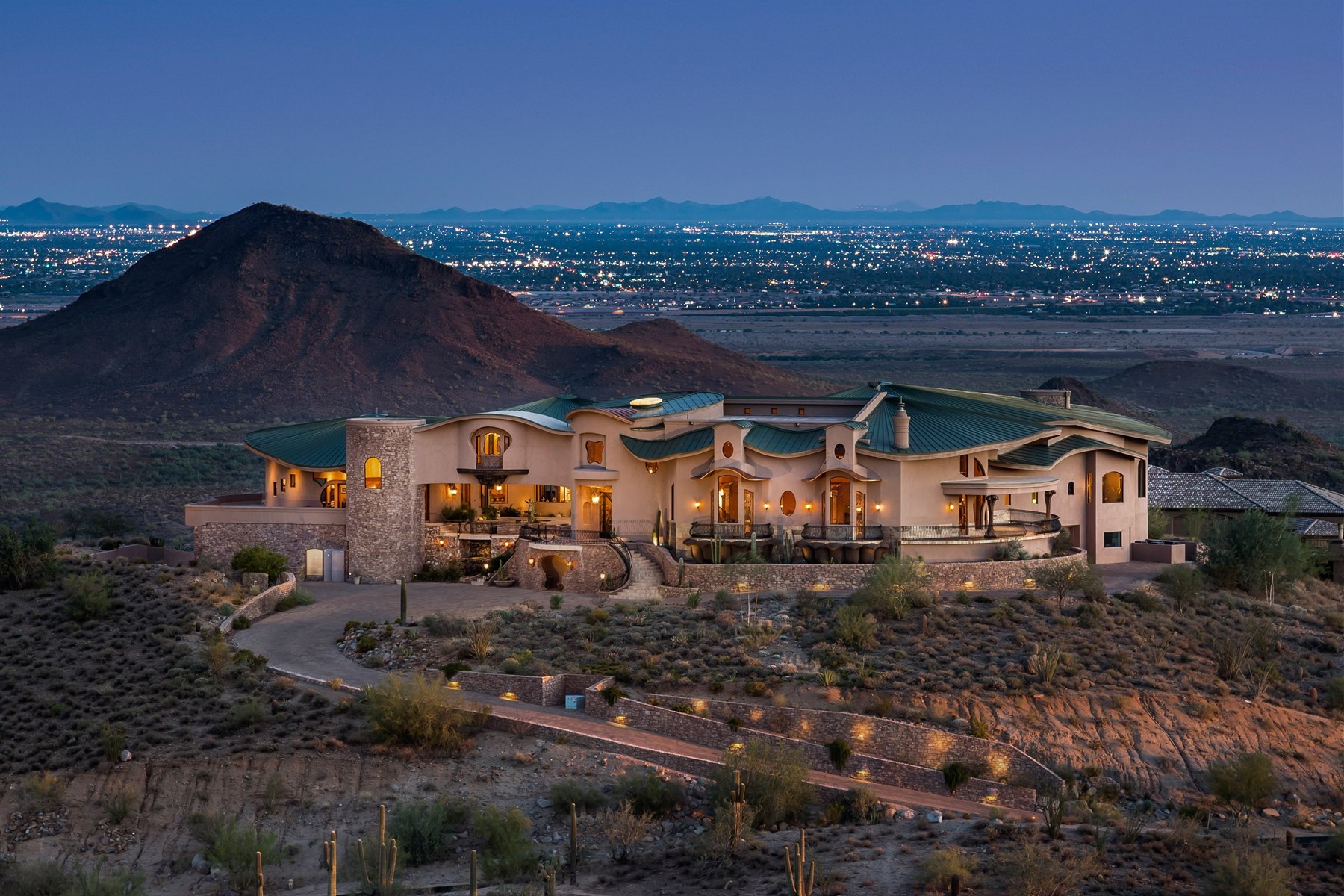
Sonoran Hillside and Rock-Outcropping Compounds: Anchored into granite mountainsides in Paradise Valley or the McDowell Mountains, utilizing natural boulders as interior and exterior structural elements. Trade-off: Dramatic elevated view corridors and privacy, offset by complex foundational engineering, difficult heavy-machinery access, and strict hillside building ordinances.
-
High-Desert Pueblo and Contemporary Adobe Revivals: Found across Santa Fe, Taos, and northern New Mexico, characterized by thick earthen walls, vigas, and organic forms. Trade-off: Superior thermal mass performance and deep cultural integration, balanced against high maintenance requirements for exterior plaster finishes and roof membranes.
-
Canyon and Mesa Desert Sanctuaries: Secluded estates nestled within red-rock canyons or dramatic plateau edges in Utah or Arizona. Trade-off: Absolute isolation and otherworldly natural beauty, offset by extreme logistical friction for construction, utility access, and emergency services.
-
Gated Golf and Country Club Mega-Compounds: Estates located within ultra-exclusive resort enclaves like The Vintage Club, Madison Club, or Desert Mountain. Trade-off: Turnkey security, immediate access to private amenities, and robust infrastructure, balanced against strict architectural review boards and reduced spatial privacy from adjacent lots.
Comparative Analysis of Desert Property Typologies
| Typology | Primary Geographic Region | Thermal Performance Profile | Infrastructure Complexity | Typical Access & Security Mode |
| Low-Desert Glass Pavilion | Coachella Valley / Palm Springs | Moderate (Requires heavy shading/HVAC) | High (Automated louvers, smart glass) | Gated community or private perimeter walls |
| Sonoran Hillside Compound | Paradise Valley / Phoenix Metro | High (Benefiting from rock thermal mass) | Very High (Retaining walls, complex grading) | Private gated driveways, hillside security |
| High-Desert Adobe Revival | Santa Fe / Northern New Mexico | Excellent (Natural earthen insulation) | Medium (Passive solar, well/septic reliance) | Rural private acreage, gated access |
| Canyon & Mesa Sanctuary | Southern Utah / Arizona Plateau | Variable (Extreme diurnal shifts) | Maximum (Off-grid power, long utility runs) | Helicopter pads, private unpaved access |
| Resort Enclave Estate | Palm Desert / Scottsdale | Moderate-High | Medium-High (Centralized community utilities) | 24-hour guarded gate, club security |
Realistic Decision Logic
When selecting a high-end desert asset, purchasers must weigh their desire for absolute architectural transparency against their tolerance for climate-induced operational friction. Buyers prioritizing effortless luxury and social connectivity typically gravitate toward master-planned resort enclaves or low-desert glass compounds, accepting neighborhood visibility and strict architectural oversight. Conversely, purchasers seeking profound seclusion and raw natural immersion must accept the operational complexities of engineering off-grid utility redundancies, private road maintenance, and defensive brush and boulder management.
Detailed Real-World Scenarios and Operational Dynamics
To understand how these properties function under operational stress, consider four distinct field scenarios encountered by estate owners and property managers.
Extreme Heat Wave and Grid Failure
A mid-summer heat wave pushes ambient temperatures above 115 degrees Fahrenheit in the low desert, coinciding with a regional power grid brownout caused by high electrical demand.
-
Failure Mode: Primary air conditioning systems trip offline simultaneously across multiple zones of an expansive glass-walled pavilion, causing interior temperatures to spike rapidly.
-
Second-Order Effect: Without immediate emergency generator engagement, delicate interior finishes warp, high-end art collections suffer humidity and thermal shock, and the residence becomes entirely uninhabitable within hours.
Monsoonal Flash Flood and Alluvial Wash Breach
A violent late-summer monsoonal thunderstorm drops inches of rain in minutes over surrounding mountain ranges, funneling millions of gallons of fast-moving water down an ostensibly dry wash intersecting a hillside estate.
-
Failure Mode: The estate’s retaining walls and culvert systems become obstructed by debris, diverting the torrent directly across the lower level and destroying custom landscaping and subterranean mechanical rooms.
-
Second-Order Effect: Catastrophic structural undermining of pool decks and foundation footings, requiring emergency civil engineering intervention and extensive insurance remediation.
Fine Desert Dust Infiltration and Mechanical Failure
A severe spring haboob (dust storm) blankets an estate in abrasive, microscopic particulate matter driven by 50 mph winds.
-
Failure Mode: Fine sand particles bypass standard weatherstripping and HVAC filtration barriers, scoring expensive sliding glass door tracks, fouling pool filtration pumps, and clogging sensitive electronic control hubs.
-
Second-Order Effect: Immediate emergency service calls for complete ductwork cleaning, motor replacements, and exterior pressure washing, accompanied by temporary system downtime.
Groundwater Well Depletion and Salinity Spike
A high-desert estate relying entirely on a private deep-water well experiences a sudden drop in water output and an increase in mineral salinity during an extended regional drought cycle.
-
Failure Mode: The well pump cavitates and burns out due to a receding water table, while the remaining water supply becomes too brackish for domestic use or landscape irrigation.
-
Second-Order Effect: Immediate necessity to truck in bulk emergency potable water while fast-tracking the installation of commercial-grade reverse-osmosis filtration systems or drilling a deeper secondary well.
Planning, Cost, and Resource Allocation
Acquiring and maintaining an ultra-prime desert compound demands rigorous economic modeling that extends far beyond the initial purchase price. Operating expenditures for desert properties are heavily influenced by the constant battle against thermal degradation, intense UV exposure, and dust mitigation.
Financial Dynamics and Cost Variability
| Expense Category | Annual Budget Range (USD) | Cost Drivers & Variables |
| HVAC & Climate Control Maintenance | $30,000 – $120,000+ | Multiple chiller units, multi-zone climate zoning, preventive coil cleaning, filter replacements |
| Landscaping & Desert Flora Management | $40,000 – $150,000+ | Irrigation line maintenance, cactus pruning, wash clearing, hardscape upkeep |
| Exterior Envelope & Glass Restoration | $50,000 – $200,000+ | Specialized window washing, UV coating repair, stucco/concrete sealing, metal shading maintenance |
| Property & Casualty Insurance Premiums | $100,000 – $500,000+ | Wildfire risk zones, flash-flood riders, high-value structural replacement costs |
Opportunity Costs and Resource Optimization
A frequent financial miscalculation involves underestimating the rate of wear and tear on exterior materials exposed to intense solar radiation and thermal cycling. Paints fade, sealants dry out and crack, wood members warp, and automated mechanical louvers seize up significantly faster than in temperate climates. Structuring capital reserves requires anticipating aggressive replacement cycles for exterior architectural elements, ensuring the physical plant does not experience deferred maintenance decay.
Tools, Strategies, and Support Systems
Successfully managing an isolated or expansive desert compound requires a sophisticated ecosystem of specialized physical assets, digital platforms, and operational personnel.
-
Smart-Home Climate Automation Platforms: Integrated software systems monitoring multi-zone temperatures, humidity levels, motorized solar shades, and automated glass louvers to optimize thermal performance passively.
-
On-Site Backup Power Generation Hubs: Commercial-grade diesel or propane generators paired with high-capacity battery storage arrays to guarantee continuous operation of life-safety and cooling systems during grid failures.
-
Advanced Water Filtration and Storage Cisterns: Multi-stage reverse-osmosis purification plants tied to large underground storage tanks to buffer against well yield fluctuations or municipal delivery interruptions.
-
Specialized Dust and HVAC Filtration Units: Hospital-grade HEPA filtration systems integrated into air handlers to capture microscopic desert particulate matter before it damages electronics or interiors.
-
Dedicated Desert Landscaping and Drainage Equipment: Heavy-duty utility vehicles, trenchers, and erosion-control materials to maintain private washes, swales, and retaining walls after storm events.
-
Professional Estate Management Teams: Resident or on-call technical personnel capable of executing immediate HVAC diagnostics, security monitoring, and contractor oversight.
-
High-Resolution Thermal and Perimeter Security Grids: Advanced optical and thermal imaging cameras capable of monitoring vast desert acreage boundaries without false alarms triggered by native wildlife.
-
Emergency Air and Ground Medical Protocols: Pre-established response plans for severe dehydration, heat stroke, or venomous wildlife encounters, ensuring rapid transit to regional trauma centers.
Risk Landscape and Failure Modes
The risk profile of desert real estate combines standard high-end property vulnerabilities with unique systemic hazards driven by extreme climatic exposure and environmental volatility.
Compounding Risks in Arid Ecosystems
-
The Thermal-Mechanical Cascade: A single HVAC system failure during a peak heat wave can trigger structural and interior distress, warping fine woods, delaminating adhesives, and rendering the living environment dangerous within hours.
-
Wildfire and Ember Storm Proximity: Surrounding desert scrub, paloverde trees, and dry arroyo vegetation create extreme wildfire vulnerabilities, particularly when high winds loft burning embers across defensible space perimeters.
-
Flash Flood Erosion Dynamics: Sudden water movement can compromise foundational pylons, undercut swimming pools, and erode private access roads, isolating the estate entirely from municipal infrastructure.
-
Regulatory Water Restrictions: Shifting state water rights and municipal conservation mandates can severely restrict landscape irrigation quotas, threatening millions of dollars of imported tropical or non-native vegetation.
Governance, Maintenance, and Long-Term Adaptation
Preserving the structural integrity and aesthetic value of a desert compound requires disciplined adherence to preventive maintenance protocols and continuous environmental monitoring.
Monitoring and Review Cycles
Estate managers must execute structured seasonal audits, evaluating roof membranes, solar panels, stucco cracking, caulk seals, and drainage culverts before the onset of peak summer heat and immediately following the winter storm season.
Layered Maintenance Checklist
-
HVAC and Chiller Overhauls: Comprehensive servicing of compressors, refrigerant levels, and filtration media before ambient temperatures cross critical thresholds.
-
Exterior Envelope Sealing: Inspection and re-application of UV-resistant sealants around window frames, expansion joints, and flat roof parapets.
-
Drainage and Wash Inspection: Clearing debris from culverts, check dams, and catch basins to ensure unobstructed water flow during monsoonal storm events.
-
Defensible Space and Brush Clearance: Pruning native and ornamental vegetation away from structures to maintain mandated wildfire safety perimeters.
Measurement, Tracking, and Evaluation
Evaluating the operational efficiency, safety, and long-term asset health of a desert estate requires tracking both quantitative parameters and qualitative resilience indicators.
-
Quantitative Metrics: Kilowatt-hour energy consumption efficiency ratios relative to ambient temperature, water usage volumes per square foot of living space, HVAC runtime diagnostic logs, and annual maintenance expenditure ratios.
-
Qualitative Signals: Indoor air quality stability, comfort levels during extreme weather anomalies, seamless regulatory compliance with water districts, and structural envelope weatherproofing durability.
-
Documentation Standards: Maintaining an exhaustive digital ledger recording all historical HVAC service records, structural engineering surveys, water table telemetry data, and architectural modification approvals ensures institutional memory across ownership transitions.
Common Misconceptions and Oversimplifications
-
Myth: Desert homes require minimal maintenance because there is no moisture or snow damage to contend with.Correction: Intense ultraviolet radiation, extreme thermal expansion and contraction, windblown dust, and flash-flood dynamics create aggressive wear and tear that demands constant specialized maintenance.
-
Myth: You can plant lush, tropical green lawns anywhere in the desert as long as you have enough money to pay the water bill.Correction: Rising water costs, strict municipal conservation codes, and severe drought restrictions increasingly penalize or prohibit non-native turf grass installations.
-
Myth: Off-grid solar power systems in the desert are maintenance-free due to constant sunshine.Correction: Dust accumulation rapidly degrades photovoltaic efficiency, requiring frequent specialized panel washing, while extreme heat reduces battery storage lifespan.
-
Myth: Building on a rocky desert hillside is structurally simpler because you are building directly on solid ground.Correction: Blasting, precision rock excavation, specialized anchoring, and complex retaining wall engineering make hillside construction vastly more expensive and complex than flatland development.
-
Myth: Desert properties are safe from water damage because it rarely rains.Correction: When desert rain does fall, it frequently arrives in violent, unabsorbed downpours that cause severe flash flooding and structural erosion.
-
Myth: Standard architectural designs used in temperate regions can be easily adapted to the desert with a larger air conditioning system.Correction: Without proper solar orientation, thermal mass, and shading design, oversized HVAC systems will run continuously, leading to premature mechanical failure and exorbitant energy costs.
Ethical, Practical, and Contextual Considerations
Acquiring and operating an ultra-prime desert compound carries a profound ecological and social responsibility. Deserts are fragile, highly sensitive biomes that support unique flora and fauna adapted to extreme conditions. Responsible stewardship mandates minimizing environmental footprints through dark-sky lighting compliance to protect nocturnal wildlife, utilizing native xeriscaping that preserves local watersheds, and respecting ancient indigenous cultural landscapes. Furthermore, acknowledging regional water scarcity and participating in community-level conservation initiatives ensures that private luxury coexists harmoniously with the broader ecological health of the American arid zone.
Conclusion
The acquisition and curation of premier desert real estate represent the ultimate synthesis of advanced environmental engineering, climate-responsive architecture, and spatial audacity. By moving past the superficial aesthetic of warm-weather leisure and confronting the relentless operational realities of thermal management, water security, dust mitigation, and extreme weather dynamics, owners can establish enduring sanctuaries of privacy and visual poetry. Whether tracing the modernist glass pavilions of the Coachella Valley, anchoring compounds into the granitic ridges of the Sonoran highlands, or retreating to high-desert mesas, these exceptional properties demand a synthesis of rigorous operational discipline, financial commitment, and deep ecological respect, balancing modern technological mastery with the timeless, unyielding power of the desert landscape.